· Dax · Dialect Guide · 10 min read
The Complete Guide to Madrid Spanish Slang (Madrileño)
You studied Spanish. You can hold a conversation. Then you land in Madrid and people start saying things like "mola mazo" and "estoy flipando" and none of it makes sense. Here is what you actually need to know.
You took a Spanish class. Maybe two. You watched a few shows and made it through the basics. Then you land at Barajas, take the metro into the city, and your new coworker greets you with “oye tío, ¿qué hay?” and your brain stalls completely.
You understood every individual word. Sort of. But the combination, the speed, the tone: total blank.
This is not a vocabulary problem. This is a calibration problem. Madrid Spanish is its own thing. It sounds different from what most people learn, uses words you will not find in any standard Spanish course, and moves fast. Very fast.
This guide covers what actually matters: the pronunciation shift, the essential slang, and the social rituals you need to understand before someone invites you for vermú and you stare back at them blankly.
The Sound That Will Throw You Off First
The single biggest adjustment is the “th” sound.
In Madrid (and across most of Spain), the letter “c” before “e” or “i” is pronounced like the “th” in “think.” Same with the letter “z.” This is called distinción: Madrid keeps the “th” sound for c and z while keeping a regular “s” for the letter s. The two sounds stay distinct.
So “gracias” in Madrid does not sound like “GRA-syahs.” It sounds like “GRA-thyahs.” Barcelona is not “Bar-se-LO-na.” It is “Bar-the-LO-na.” “Cinco” is “THEEN-ko.”
This is not a speech impediment. It is not affectation. It is simply how the language sounds here and has sounded for centuries. Your brain will flag it as unusual for the first two or three days, then it will disappear into the background noise.
The second thing: the speed. Madrid Spanish is clipped and fast. Syllables get swallowed. “Para ti” collapses toward “pati.” “¿Qué estás haciendo?” comes out more like “¿Questasasiendo?” in casual speech. You will not catch every word for a while and that is completely normal. Your ear adjusts faster than you think if you stay immersed.
The third thing: the tone. Madrileños are direct. Blunt, even. This is not rudeness. It is the communication style of the city. When someone at a bar says “¿qué quieres?” without a smile, they are doing their job efficiently. They are not being rude to you specifically.
Vosotros: The Pronoun You Might Not Know
If you learned Spanish from Latin American teachers or materials, here is something that will catch you: vosotros.
In Madrid, “vosotros” is the standard informal plural “you.” Talking to a group of friends? “¿Cómo estáis vosotros?” (How are all of you?) “¿Queréis venir?” (Do you want to come?) “¿A qué os dedicáis?” (What do you all do?)
In Latin America, this form does not exist in everyday use. Everyone uses “ustedes” for groups, formal or informal. In Madrid, “ustedes” sounds stiff or formal in casual settings. It is used with strangers, in professional contexts, and in writing.
If you drop “ustedes” in casual conversation with friends in Madrid, no one will misunderstand you. But it marks you as someone who learned a different variety. Start noticing vosotros and its verb conjugations (“estáis,” “queréis,” “tenéis”) and your ear will catch it within a week.
The Phrases That Actually Matter
Greetings and Daily Life
Tío / Tía (TEE-o / TEE-a)
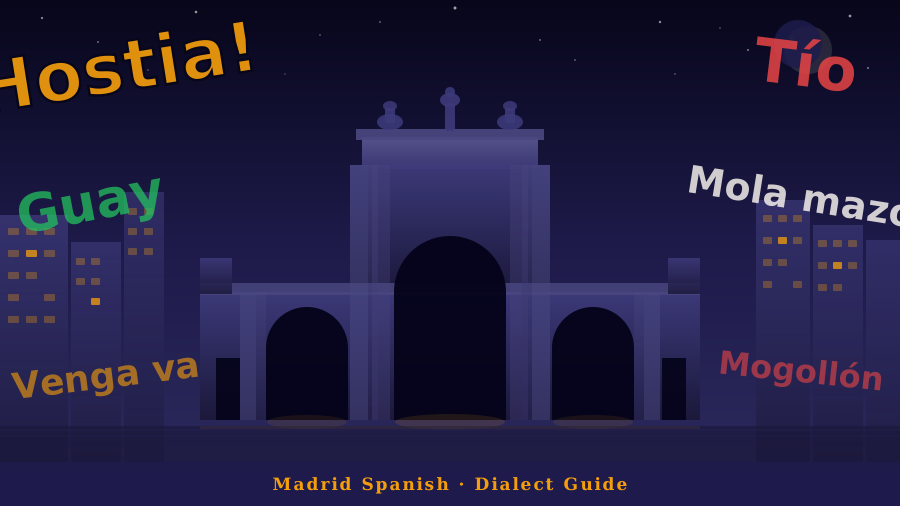
This is your most important word in Madrid. Literally “uncle/aunt” but used constantly as casual address between people who know each other. Closest English equivalent: “dude,” “man,” “mate.” Women say “tía” to each other. Men say “tío” to men. Mixed groups use both. “Oye tío, ¿qué pasa?” means “hey man, what’s up?” You will hear this dozens of times a day.
¿Qué pasa? (keh PA-sa)
A common casual greeting in Madrid. Literally “what’s happening?” but functions as a general hello between people who know each other. Used throughout the Spanish-speaking world, and you will hear it constantly on Madrid streets.
¿Qué hay? (keh AI)
Even more casual. Short for “¿qué hay de nuevo?” (what’s new?). The “h” in “hay” is silent. Use it with people you already know. With strangers it sounds a bit presumptuous.
Chaval / Chavala (cha-VAL / cha-VA-la)
Literally “kid” or “young person.” Used affectionately or when referring to someone. “Oye chaval” as an attention-getter means something like “hey mate” or “hey there.” You will hear older Madrileños use this toward younger people constantly.
Venga va (VEN-ga va)
You will hear this at the end of almost every conversation. It means “okay,” “alright,” “let’s go,” “sounds good.” It closes a plan, confirms an arrangement, acknowledges something. “Quedamos a las nueve.” “Venga va.” Also used as encouragement before someone does something. Two words. Learn them together.
Food, Bars, and the Rituals You Need
El vermú (el ver-MU)
Not just a drink. The Sunday pre-lunch ritual of meeting friends for vermouth, olives, and small plates of food at a neighborhood bar. Starts around noon, runs until about 2pm when everyone moves on to lunch. If someone invites you to “el vermú,” they are inviting you into one of Madrid’s core social institutions. Go.
Bocata (bo-KA-ta)
The informal word for bocadillo, the Spanish baguette sandwich eaten everywhere. “Me pido un bocata de calamares” = “I’m getting a squid sandwich.” You will see “bocata” far more than “bocadillo” in casual conversation. The calamares sandwich at a bar near Puerta del Sol is, genuinely, an institution.
¿Hacemos una ruta de tapas? (a-SEH-mos oo-na ROO-ta deh TA-pas)
“Shall we do a tapas route?” The classic Madrid social plan: walking from bar to bar, having a drink and a tapa at each stop. Some Madrid bars still throw in a free tapa with each drink, though the strongest free-tapa tradition in Spain lives in Granada and León. Knowing this phrase (and knowing that this is a real thing people do on a Tuesday night) marks you as someone who actually lives here.
One timing note: dinner in Madrid does not happen at 7pm. It barely happens at 8pm. Madrileños typically eat dinner between 9pm and 11pm. If you walk into a restaurant at 7:30 and it is empty, that is not a bad sign about the food. That is just Tuesday.
Expressions You Will Use Every Day
Guay (gway)
Cool. Awesome. Great. “Está guay” = that’s cool. “¿Qué guay!” = how cool. This word does not exist in Latin American Spanish. It is one of the most reliable markers of Madrid speech. Start using it in context and people will notice.
Molar / Mola (mo-LAR / MO-la)
The verb “molar” means to be great, to be cool, to be excellent. “Mola mazo” = it’s really great. “¿Te mola el plan?” = do you like the plan? “Esto mola mucho” = this is really good. One of the most common casual verbs in daily Madrid conversation.
Mogollón (mo-go-YON)
A lot. Tons. A huge amount. “Hay mogollón de gente” = there are loads of people. “Me gusta mogollón” = I really like it a lot. “Mogollón de veces” = loads of times. Very distinctly Madrileño. Use it and you will sound immediately more local.
Mazo (MA-tho)
Also means “a lot” or “really.” Interchangeable with mogollón in many contexts. Often appears with “mola”: “Mola mazo.” Or alone: “Hay mazo de gente.” Slightly more youth-oriented than mogollón but both are extremely common.
Flipar (fli-PAR)
To be blown away. To be amazed. To love something intensely. “Me flipa este sitio” = I love this place / this place blows me away. “Estoy flipando” = I can’t believe it / I’m totally amazed. “Me flipa cómo hablan” = I’m amazed at how they talk. Very Madrid, very informal.
Hostia (OS-tya)
This is a strong expletive used casually across the full spectrum of Madrid speech. Tone determines meaning: surprise, pain, admiration, frustration. You will hear it in cafes, offices, street conversations, and from people of all ages. Be aware of what it literally refers to (the Communion wafer in Catholic practice) but understand that in Madrid street speech it functions as a general-purpose emphatic particle, roughly equivalent to “bloody hell” in British English.
Work and Everyday Practicalities
Curro (KU-ro)
Job. Work. “Tengo curro mañana” = I have work tomorrow. “Voy al curro” = I’m heading to work. “Currar” is the verb: to work. This is the standard Madrid word in casual speech. “Trabajo” sounds more formal or written. If you say “tengo trabajo mañana” to a friend, you’ll be understood but it sounds textbook.
Mañana lo hacemos (ma-NYA-na lo a-SEH-mos)
“We’ll do it tomorrow.” Sometimes this is a genuine commitment. Often, especially in casual contexts, it means “sometime soon, don’t stress.” Madrid has a relaxed relationship with scheduling outside of professional settings. Read the energy. If someone says it while already checking their phone, treat it as a gentle deferral.
What You Probably Know vs. What Madrid Actually Uses
If you learned Latin American Spanish, here are some key vocabulary swaps:
| You might say | Madrid says | Meaning |
|---|---|---|
| Chido / Chévere | Guay | Cool |
| Güey / Bro | Tío / Chaval | Dude / Mate |
| Chamba | Curro | Job / Work |
| Un chingo / Montón | Mogollón / Mazo | A lot |
| Molar, estar de pelos | Mola mazo | It’s great |
| Buena onda | Buen rollo | Good vibes |
Neither version is wrong. They are just different cities. The same way a New Yorker and someone from Sydney both speak English but sound completely different and use different words for the same things.
The Neighborhoods Where Language Actually Matters
Malasaña is where young, creative Madrid lives. Bohemian, lots of bars, good mix of locals and incoming residents. More English floating around than some parts of the city, but Spanish is still the default in every interaction.
Lavapiés is dense, multicultural, and genuinely local. North African and South Asian communities mix with working class Madrileños. Spanish is essential here. It is also one of the best neighborhoods for real street-level practice because the conversations are actual: corner stores, neighborhood bars, street markets.
Chueca is lively and very Spanish speaking. Welcoming and good for building conversational confidence if you are in the early stages.
Sol and Gran Vía are the tourist center. Landmark concentration means more English around Puerta del Sol. Step one block off the main drag in any direction and you are back in functional Madrid Spanish territory. The Puerta del Sol is the symbolic heart of the city: beautiful, busy, and probably not where you will learn the most useful Spanish.
Textbooks vs. What Madrid Sounds Like
A standard Spanish course gives you: full sentences, neutral grammar, formal vocabulary, and pronunciation that is designed to be universally understood. It is optimized for comprehension across the broadest possible audience.
What Madrid sounds like: fast, clipped, heavily slang-inflected, with distinción (the th for c/z), with vosotros, and with a direct communication style that can read as blunt if you are not calibrated to it.
The gap is not about fluency. It is about calibration. Once you understand the rhythm and the key words, you stop sticking out and start fitting in. That shift happens faster than most people expect: usually within the first two to three weeks of real immersion.
The distinción is the most disorienting thing for new arrivals. It takes active, deliberate exposure to normalize. Passive exposure (listening to podcasts, watching shows) helps but is slower. Active practice in real conversations is faster.
Start Here
If you are moving to Madrid or spending serious time there, the pronunciation shift is the first thing to work on. Not because your accent needs to be perfect, but because you need your ear to stop treating the distinción (the th) as unusual. That is the single biggest thing between sounding like you belong and sounding like you just landed.
For a wider look at how Madrileño Spanish compares to what you might already know, the post on Mexican Spanish vs Spain Spanish covers the structural differences in detail.
If you learned Spanish from Latin American materials, that context is also useful before arriving in Barcelona: see the Barcelona Spanish and Catalan guide for how things shift further along the peninsula.
The Madrid Spanish page in the StreetTongue app has the full phrase set, interactive pronunciation training, and conversation scenarios built around real Madrid situations.
Language and slang shift over time and vary by speaker, neighborhood, and context. This guide reflects our research at the time of its last update (Apr 22, 2026) and may be outdated or incomplete. Verify anything you plan to rely on, including any third party pricing or business details mentioned here.
See our Terms of Service for details.