· Dax · Dialect Guide · 9 min read
The Complete Guide to Barcelona Spanish (and Catalan): What Expats Need to Know
Barcelona is bilingual. The Spanish spoken here sounds nothing like Mexico City, and Catalan is everywhere. This is what you actually need to navigate daily life in BCN.
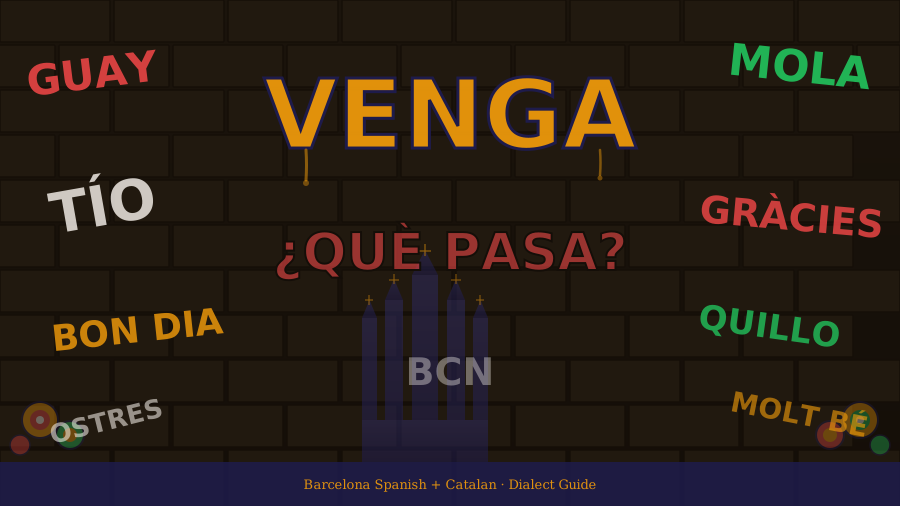
My first day in Barcelona, I walked into a bakery in the Born neighborhood and asked for bread in what I thought was solid Spain Spanish. The woman behind the counter smiled and responded in something that was definitely not Spanish.
It was Catalan.
Two weeks of prep, and I was out of my depth in the first five minutes.
Barcelona is not just another Spanish city. It is a bilingual city. Catalan and Spanish share public space, signage, and conversation in ways no language app ever tells you. The Spanish spoken here carries Catalan fingerprints: different vocabulary, different pronunciation patterns, a different melodic rhythm from anything you might have learned from Latin American Spanish.
This guide covers what you actually need before arriving. Practical Spain Spanish for Barcelona, with the Catalan basics you need to not look completely clueless.
The Bilingual Reality
Before getting into phrases, you need to understand the setup.
Barcelona has two official languages: Catalan and Spanish (Castilian). Government documents and official signage are in Catalan. Most people speak both fluently and switch between them depending on context, neighborhood, and relationship. Gràcia and Poblenou lean Catalan. Barceloneta and the Eixample are more mixed. Anywhere in the old town (Barri Gòtic, Born) you will hear both within the same hour.
One thing matters above everything else: Catalan is not a dialect of Spanish. It is a separate Romance language, descended from Latin along a different branch than Spanish. Locals feel strongly about this distinction, and they are right to. Calling it a dialect will not make friends.
The practical good news: you do not need to speak Catalan to function in Barcelona. Spanish works everywhere. But knowing even ten basic Catalan words will open doors and earn genuine warmth that Spanish alone does not.
Spain Spanish Basics: What You Actually Hear
Tío / Tía
The most common casual address in Spain Spanish. Roughly equivalent to “man” or “dude” in English. ¿Qué pasa, tío? is the standard casual Barcelona greeting between friends.
One critical note: do not use tío/tía in Mexico City. There it means literally uncle or aunt. The Spain casual usage sounds bizarre, not friendly.
Pronunciation: TEE-oh. Two syllables, stress on the first, short and clipped.
Venga
The single most useful word in Spain Spanish. It means okay, come on, let’s go, alright, I understand, and goodbye, all depending on tone and context.
- Venga, nos vamos = Okay, let’s go
- ¡Venga! (enthusiastic) = Let’s do it! Come on!
- Venga, hasta luego = Alright, see you later
- Venga, venga (quick, on the phone) = Okay, goodbye
You will hear this a hundred times a day. Start using it immediately.
Pronunciation: VEN-ga. Two syllables, stress on the first.
Guay
Cool, great, nice. The Spain equivalent of chido in Mexico. Está guay = that’s cool. ¡Qué guay! = how great.
Not used in Latin America. If you say está guay in Mexico City, people will understand you but immediately know you learned Spain Spanish, which is perfectly fine.
Mola
From the verb molar, meaning to be great or cool. ¡Mola mucho! = it’s really great. ¿Te mola? = do you like it?
Both guay and mola circulate in Barcelona. You’ll hear both in the same bar. Either works.
Quillo / Quilla
Casual friend address, borrowed from Andalusian slang. ¿Qué pasa, quillo? = what’s up, mate? More street-level than tío. Know it when you hear it; use it once you have a feel for the register.
At the Bar (Which Is Everything in Barcelona)
Bar culture in Barcelona is not about drinking. A Spanish bar is where you eat breakfast (toast with tomato), have coffee at any hour, eat a quick lunch standing at the counter, and spend evenings talking. Learning bar vocabulary is essential, not optional.
¿Me pones…?
This is how you order at a bar counter. Not quiero (I want) as you might say elsewhere, and not me da as you’d use in Mexico. In Spain, the standard polite order is ¿me pones una caña? (can you pour me a small beer?). Literally “can you put me…” but functionally it’s just how you ask for things.
Examples:
- ¿Me pones un café con leche? = Can I get a white coffee?
- ¿Me pones una tostada con tomate? = Can I get a toast with tomato?
- ¿Me pones la cuenta? = Can I get the check?
Una Caña
A small draft beer. Around 200ml. Cold, cheap, and the default beer order at any bar. If you want a larger beer, ask for una jarra or un tubo depending on what the bar offers.
Pronunciation: KA-nya. The ñ makes the “ny” sound as in “canyon.”
La Tostada con Tomate
This is the Barcelona breakfast. Thick toast rubbed with fresh tomato, olive oil, and salt, sometimes with jamón on top. It costs 1.50 to 3 euros at a local bar and is genuinely excellent. To order: una tostada con tomate, por favor.
If you want to try ordering in Catalan: una torrada amb tomàquet, si us plau.
¿Hay tapas?
Barcelona tapas usually cost money, unlike some other Spanish cities where they come free with a drink. Ask ¿hay tapas? before assuming they’re included. A handful of Basque-themed bars in Barcelona also serve pintxos (small bites on bread with a toothpick), a tradition imported from San Sebastián. They’re not a Barcelona staple, but they’re widely available if you’re curious.
The Catalan Layer: Phrases Worth Learning
Even if you never try to learn full Catalan, these words will make a genuine difference in how locals respond to you.
Gràcies (GRAH-syuhs)
Thank you. Use this in shops, restaurants, and wherever you’d normally say gracias. In Barcelona, switching to gràcies signals cultural awareness and earns a noticeably warmer response. It costs nothing and gains a lot.
Bon Dia / Bona Tarda / Bona Nit
Good morning, good afternoon, good night. These three cover all basic greetings by time of day.
Bon dia in the morning is probably the highest-value single Catalan phrase you can learn. Walk into any local bar at 8am, say bon dia instead of buenos días, and watch the difference.
Pronunciation: bohn DEE-uh / BO-nuh TAR-thuh / BO-nuh NEET. Unstressed vowels in Eastern Catalan reduce toward a schwa sound, so the final syllables are shorter and softer than the spelling suggests.
Molt Bé
Very good, great. You will hear this constantly from shop owners and servers confirming your order. Molt bé, gràcies = very good, thank you. Knowing it means you don’t stand there confused when someone says it. Pronunciation note: the ‘t’ in molt is silent before a consonant in Barcelona Catalan. It sounds like “mol BEH,” not “molt BEH.”
Si Us Plau
Please. The everyday Catalan word for please, not more formal than por favor. It’s the direct register equivalent in a different language. Use it in shops, bars, restaurants, anywhere you’d say por favor in Spanish. Locals notice and appreciate it.
Ostres
A mild exclamation of surprise or mild frustration. Catalan equivalent of “gosh” or “crikey.” Literally means “oysters” and serves as a polite stand-in for a much stronger word. You’ll hear it constantly. It’s inoffensive and shows you’ve been listening. Pronunciation note: the unstressed final syllable reduces to a schwa, closer to “OS-truhs” than a clear “OS-tres.”
Pronunciation: Spain Spanish vs What You Might Have Learned
If you learned Spanish from Latin American sources, two things will immediately sound different in Barcelona.
The “th” Sound
In Spain, the letters c (before e or i) and z are pronounced like the English “th” in “think.” This is the most immediately noticeable difference from Latin American Spanish.
| Word | Latin American | Spain/Barcelona |
|---|---|---|
| Gracias | GRA-see-as | GRA-thee-as |
| Barcelona | Bar-seh-LOH-na | Bar-theh-LOH-na |
| Cerveza | ser-VEH-sa | ther-VEH-tha |
| Zumo | SOO-mo | THOO-mo |
Neither is wrong. They are regional standards. If you use the Latin American pronunciation, locals will understand you fine and simply know you learned a different variant. It’s not something anyone minds.
Vosotros
Spain uses vosotros as the informal plural “you,” used with groups of friends. Latin American Spanish doesn’t use this form. In Latin America, ustedes covers both formal and informal plural.
In Barcelona you’ll hear:
- ¿Dónde vais? = Where are you all going? (casual)
- ¿Queréis venir? = Do you all want to come?
- ¿Vosotros sois de aquí? = Are you from here?
You don’t need to use vosotros if it feels unnatural. Locals will understand ustedes with no problem. But you should recognize it when you hear it, because you will hear it constantly.
Words That Confuse Latin American Spanish Speakers
Coger
In Spain, coger means to grab, to take, or to catch. Completely neutral. Voy a coger el metro = I’m going to take the metro.
In Mexico and most of Latin America, coger is a vulgar term for sex. This is the single most embarrassing false friend in Spanish. In Barcelona, use coger freely. In Mexico City, say tomar el metro.
Ordenador vs Computadora
Spain says ordenador for computer. Latin America says computadora or computador. Both will be understood, but ordenador is what you’ll hear in Barcelona.
Móvil vs Celular
Spain says móvil for mobile phone. Latin America says celular. In Barcelona: ¿Tienes el móvil? (do you have your phone?).
The Neighborhoods That Matter for Language Practice
Gràcia is the best neighborhood for real practice. It is the most locally feeling central neighborhood. Genuine plazas full of residents, not tourists. Local bars where people live around the corner. More Catalan spoken here than in touristy areas. If you want to feel what Barcelona actually sounds like day to day, spend time in Gràcia.
El Born / Sant Pere is bilingual and friendly. Good for practicing in a less pressured environment. You will meet a mix of long-term residents and international professionals.
Poblenou is the 22@ tech and creative district. Spanish, Catalan, and English all circulate depending on the context. Local bars lean Catalan; tech offices default to English. A good window into how working-age Barcelona actually operates.
Barceloneta in summer is heavily tourist-oriented and not useful for language practice. Barceloneta from October to April is a different place: genuinely local, quieter, and excellent for practice.
Las Ramblas: skip it for language purposes entirely. It is tourist infrastructure, not a neighborhood.
Before You Arrive
The highest-value thing you can do before landing in Barcelona is fix your pronunciation and train your ear. Not to fake a perfect Catalan accent. But to recognize gràcies when you hear it, to produce the th sound without hesitation, and to use venga and ¿me pones? automatically.
StreetTongue has the full Barcelona phrase library, with pronunciation scoring for both Spain Spanish vocabulary and the essential Catalan phrases. Practice before you land, not after.
Learn Barcelona Spanish with StreetTongue →
Ready to buy? See what’s included →
Language and slang shift over time and vary by speaker, neighborhood, and context. This guide reflects our research at the time of its last update (Mar 27, 2026) and may be outdated or incomplete. Verify anything you plan to rely on, including any third party pricing or business details mentioned here.
See our Terms of Service for details.