· Dax · Dialect Guide · 10 min read
The Complete Guide to São Paulo Portuguese Slang (Paulistano)
Paulistano Portuguese is fast, direct, and shaped by a century of Italian and Japanese immigration. Here is what you actually need to speak like someone who lives in SP, not someone who downloaded an app.
You land at Guarulhos and grab an Uber. The driver speaks fast, points at the traffic, and says something about “trampo” and “pauleira.” You studied Portuguese. You know “trabalho” and “difícil.” But this sounds like a different language.
You smile and say “tudo bem.” He nods. The ride starts.
That gap between what you studied and what you just heard: that is Paulistano Portuguese.
This guide closes that gap.
What Is Paulistano Portuguese?
São Paulo is Brazil’s economic engine. Twenty two million people in the metro area. The largest Japanese community outside Japan. A city that received more Italian immigrants than any other city outside Italy. And a pace that makes everything, including the language, move faster.
Paulistano Portuguese, named after people from the city itself (“paulistanos”), has its own character:
- Flatter and faster than Rio Portuguese (Carioca)
- Less musical in rhythm but very expressive in vocabulary
- Shaped by Italian and Japanese immigration in ways that show up in daily speech
- Full of work culture and street slang that no app or textbook covers
This is not the Portuguese of Duolingo or your evening class. This is what people actually say at the bakery, the bar, the office, and the corner padaria at 7am.
Paulistano vs What You Learned
If you studied Portuguese from an app, you got either European Portuguese (Portugal-style) or a neutralized “standard” Brazilian Portuguese. Both leave gaps in São Paulo.
Here is the quick version:
| What you learned | What SP says |
|---|---|
| trabalho (work) | trampo |
| amigo (friend) | mano, cara |
| muito bom (very good) | baita |
| obrigado (thanks) | valeu |
| festa ou clube (party or club) | balada |
| difícil, cansativo (hard, tiring) | pauleira |
The vocabulary gap is real. Let’s go through it phrase by phrase.
Greetings: How to Open a Conversation
Oi / Tudo bem?
Forget “olá” for anything casual. São Paulo runs on oi (pronounced “oy”) and tudo bem? (TOO-do beng, literally “everything good?”).
The standard exchange goes like this:
Person 1: “Oi! Tudo bem?” Person 2: “Tudo! E você?”
“Tudo!” alone is a complete answer meaning “everything’s good.” You will say this twenty times a day. In Portugal you’d hear “tudo bem” less as a greeting opener. In Brazil, and especially in SP, it is the default.
Cara / Mano / Mana
These are your casual address words in SP. Think of them as “dude” or “man.”
Cara (KA-ra): gender neutral in practice. Used by everyone, all the time.
Mano (MA-no): short for irmão, meaning brother. Very São Paulo. You will hear this constantly.
Mana (MA-na): the female version. Short for irmã, meaning sister.
Once someone uses mano with you, you are in. It is a signal of comfort and familiarity. You can use it back.
“Cara, que dia longo.” (Dude, what a long day.) “Tô cansado, mano.” (I’m tired, man.)
Valeu
Valeu (va-LEH-oo): casual thank you. More informal than obrigado. Also works as “got it,” “cool,” or “sounds good.” Three expressions in one word.
“Valeu pela ajuda!” (Thanks for the help!) “Tá bom. Valeu.” (Alright. Got it.)
Use valeu wherever you would say “thanks, cool, or appreciate it” in English and you will land in the right range every time.
Work and the SP Grind
São Paulo takes work more seriously than any other Brazilian city. The language reflects it.
Trampo
Trampo (TRAM-po): work, job, or gig. This is the word you need for anything work related in casual conversation. Nobody says “trabalho” when talking to a friend.
“Tô no trampo até as sete.” (I’m at work until seven.) “Tem um trampo bom aí?” (Is there a good job there?) “Como vai o trampo?” (How’s work going?)
Pauleira
Pauleira (pow-LAY-ra): a brutal, overwhelming stretch of work or life. Very SP.
“Que pauleira essa semana.” (What a brutal week.) “Tô numa pauleira louca.” (I’m in the middle of an insane grind.)
This word exists because São Paulo needed a word for it. Other Brazilian cities do not use it the same way because no other city lives it the same way.
Tô ligado
Tô ligado (toh lee-GA-do): “I’m aware,” “I get it,” or “I’m with you.” Short for estou ligado.
“Tô ligado no que está rolando.” (I know what’s going on.) “Tô ligado, cara.” (I’m with you, man.)
Female speaker: tô ligada. You will hear this in offices, over coffee, and in conversation everywhere.
At the Coffee Counter: The Cafezinho Ritual
São Paulo runs on coffee. Not iced lattes. Not cold brew. Cafezinho. A tiny, strong espresso served in a small ceramic cup, often free at the counter of any decent restaurant, bakery, or diner.
Um cafezinho, por favor
Cafezinho (ka-feh-ZEE-nyo): literally “little coffee.” The standard SP order.
“Um cafezinho, por favor.” (A small coffee, please.)
The “-inho” diminutive ending appears everywhere in Brazilian Portuguese. It softens requests and signals warmth. Asking for a cafezinho instead of just a café marks you as someone who knows how things work here.
One cultural note: if someone offers you a cafezinho in a social or business setting, accept it. Refusing is mildly impolite. Just take the cup.
Baita
Baita (BAI-ta): an intensifier meaning “huge,” “great,” or “excellent.” Common in SP thanks to southern Brazilian roots.
“Baita café.” (Great coffee.) “Baita cidade.” (What a city.) “Baita trampo essa semana.” (A brutal grind this week.)
Put baita before almost any noun and it works as an intensifier. Positive or negative depending on context.
Nightlife and Socializing
Balada
Balada (ba-LA-da): nightclub, party scene, or a proper night out. São Paulo has one of the best nightlife cultures in South America, and balada is the only word for it.
“Vai na balada hoje?” (Going out tonight?) “Que balada foi essa!” (What a night that was!)
SP clubs run until 10am on weekends. When someone says balada, they mean a full commitment.
Oxe
Oxe (OH-shee): a reaction word expressing surprise, disbelief, mild frustration, or impressed admiration. Originally from northeast Brazil (Bahia and Pernambuco) but fully integrated into SP speech thanks to decades of internal migration.
“Oxe! Isso é verdade?” (Wow, is that true?) “Oxe, que baita lugar.” (Damn, what a place.)
Pronunciation: “oh-shee,” not anything like the spelling suggests. Brazilian internal migration brought northeast vocabulary into SP in a big way, and oxe is one of the clearest examples.
On the Street: Urban SP Vocabulary
Motoboy
Motoboy (MO-to-boi): a motorcycle delivery courier. Essential São Paulo vocabulary and not slang at all. It is just what these workers are called.
Hundreds of thousands of motoboys weave through São Paulo’s legendary traffic delivering food, packages, and documents every day. You will see them everywhere. You will interact with them constantly, whether you use delivery apps or not.
“O motoboy trouxe o pedido.” (The motoboy brought the order.)
No language app teaches this word. But you will hear it daily from your first week in the city.
Paulistano
Paulistano (pow-lees-TA-no): a person from the city of São Paulo.
This distinction matters:
- Paulistano / Paulistana: from the city of São Paulo
- Paulista: from the state of São Paulo
Getting this right signals cultural awareness. Locals notice, and they appreciate it.
“Sou paulistana.” (I’m from São Paulo city, female speaker.)
Que saudade!
Saudade (saw-DA-deh) is a word every Portuguese learner encounters. But what apps do not teach is when and how São Paulo actually uses it.
Saudade is longing, missing something or someone, the bittersweet feeling of reunion. In SP, it is not poetic or formal. It is just how people talk.
“Que saudade de você!” (I’ve missed you so much!) “Ai, que saudade dessa comida.” (Oh, how I’ve missed this food.)
You use it when you see an old friend, return somewhere you love, or eat something you had been craving for months. It comes up constantly.
Neighborhoods and Where to Practice
São Paulo is a collection of cities within a city. The language shifts by neighborhood.
Pinheiros and Vila Madalena: the creative and nightlife hub. Young, cosmopolitan, some English spoken but Portuguese is the default. Good for hearing casual SP speech and bar vocabulary.
Liberdade: the Japanese neighborhood and the largest Japanese community outside Japan. Portuguese with a Japanese cultural overlay. You will hear Japanese restaurant names woven into Portuguese conversations. One of the most linguistically interesting environments in Brazil.
Consolação and Jardins: upscale, international, food focused. Good for hearing educated Paulistano speech patterns. English friendly in many spots but Portuguese is always appreciated and will get you better service.
Itaim Bibi: business district by day, restaurant and bar scene by night. International and expat heavy but Portuguese is expected. Corporate SP speech here is notably more formal than street level vocabulary anywhere else in the city.
Paulistano vs Carioca: The Key Differences
If you studied Brazilian Portuguese before and learned Carioca (Rio) phrases, here is how SP maps against what you know:
| Situation | Rio (Carioca) | SP (Paulistano) |
|---|---|---|
| Casual greeting | E aí? / Beleza? | E aí? / Tudo bem? |
| Dude, man | Cara, véi, mermão | Mano, cara |
| Work | Trampo / serviço | Trampo |
| Thanks (casual) | Valeu | Valeu (shared) |
| Awesome | Massa!, irado | Baita, irado |
| Brutal grind | No direct equivalent | Pauleira |
The biggest difference you will hear is the accent. Rio Portuguese has the famous “sh” sound: vamos becomes “vamosh,” está becomes “eshtá.” São Paulo drops that entirely. SP sounds flatter, faster, and more neutral to outside ears. But it is just as expressive once you know the vocabulary.
If you have spent time in Rio, give yourself a week to recalibrate. You’ll get there. For a deeper look at Carioca, see the Rio de Janeiro Portuguese slang guide. And if you have studied European Portuguese or spent time in Lisbon, the Lisbon Portuguese slang guide covers where the two dialects split on key vocabulary.
Pronunciation Basics for SP Portuguese
São Paulo Portuguese is widely considered one of the clearer Brazilian accents for learners. The vowels are relatively clean, and the rhythm, while fast, is consistent. Think of it the way Mexico City Spanish is described: more neutral, easier to parse, but still full of local vocabulary that no course covers.
Key points:
- Tudo bem: the “m” at the end nasalizes the vowel, giving you “beng” not “bem” as written
- Valeu: “va-LEH-oo” with a clipped final syllable
- Mano: “MA-no” with a clear open “a”
- Baita: “BAI-ta” with emphasis on the first syllable
- Trampo: “TRAM-po,” clean and direct
The speed is the main challenge. Paulistanos talk fast because the city moves fast. Once you have the vocabulary, the speed becomes less of a barrier.
The Italian Connection You Will Feel
São Paulo received more Italian immigrants than any city outside Italy. That wave shaped the food, the architecture, and the texture of how people talk.
You will notice it in:
- Italian last names everywhere (common surnames like Ferrari, Matarazzo, Bianchi appear throughout the city)
- Food vocabulary that blends languages (nhoque, esfiha, a mortadela sandwich culture that is entirely São Paulo)
- A directness in conversational style that linguists trace partly to Italian influence
No language app teaches this. But you will feel it the moment you sit down in a SP restaurant or talk to someone whose grandparents switched between Italian and Portuguese at the dinner table.
Getting to Street Level in SP
You can survive in São Paulo with textbook Portuguese. The city is cosmopolitan. In Jardins or Itaim Bibi, English covers a lot of ground. People are generally patient with learners.
But when you are in Pinheiros on a Friday night, ordering at a corner boteco in Consolação, navigating a business conversation at SP’s pace, or just trying to follow what your Uber driver is saying, textbook Portuguese leaves you behind.
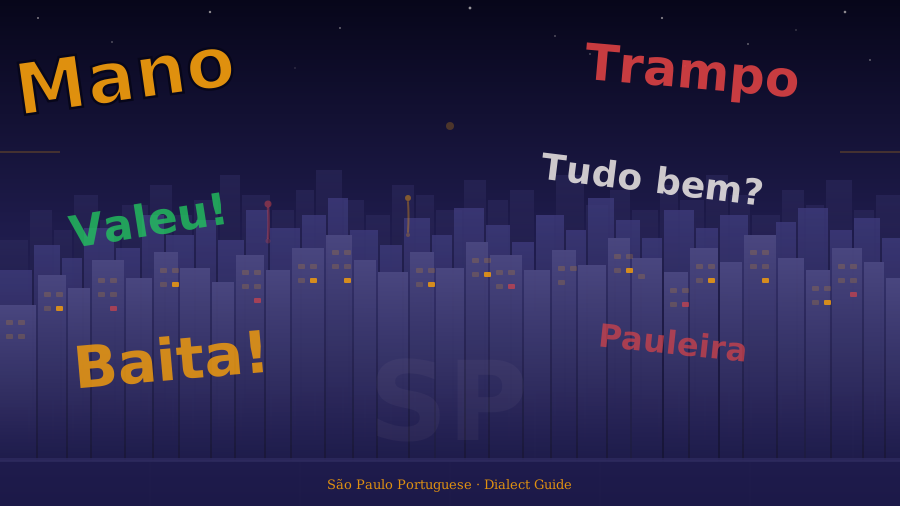
The words in this guide are a start. Mano, trampo, valeu, baita, pauleira. These are the words that make you sound like someone who lives here.
StreetTongue teaches São Paulo Portuguese at the street level: the actual phrases locals use, pronunciation coaching built around the Paulistano accent, and the cultural context that makes it all click. If you are moving to SP, working in SP, or just tired of being a beat behind every conversation, see what’s included.
Language and slang shift over time and vary by speaker, neighborhood, and context. This guide reflects our research at the time of its last update (Apr 20, 2026) and may be outdated or incomplete. Verify anything you plan to rely on, including any third party pricing or business details mentioned here.
See our Terms of Service for details.