· Dax · Dialect Guide · 12 min read
The Complete Guide to Berlin German Slang (Berlinerisch)
Berlin German is blunt, distinct, and full of shortcuts that textbooks never teach. Here is what people actually say in Kreuzberg, Friedrichshain, and beyond.
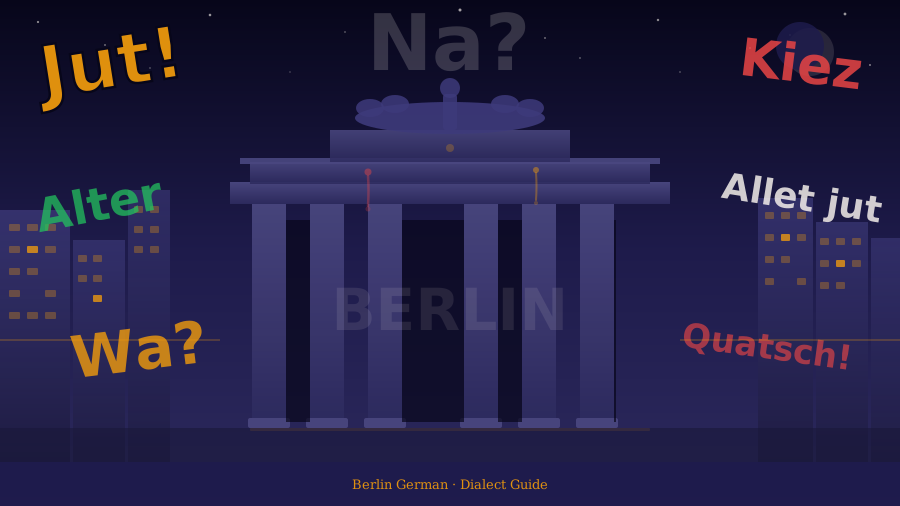
You step off the U-Bahn at Kottbusser Tor. A guy at the Späti looks you up and down and says, “Na?”
You freeze. Your three semesters of university German gave you Guten Tag, Auf Wiedersehen, and a solid grasp of der/die/das. It did not prepare you for one syllable being a complete conversation.
Welcome to Berlin.
This city has its own rhythm, its own vocabulary, and its own rules about how people talk to each other. The German you learned from a textbook works. But it marks you. The moment you say Auf Wiedersehen to a bartender in Neukölln, the room knows you are not from here.
This guide covers what people actually say in Berlin, why the dialect sounds the way it does, and how to stop sounding like a tourist six words into every sentence.
What Is Berlinerisch?
Berlinerisch is the street level dialect of Berlin. It has roots in Low German and Central German, and it sits on top of standard German (Hochdeutsch) like an accent layer.
Berlin is one of the most internationally connected cities in Europe. English is everywhere, especially in tech and creative industries. Many Berliners speak it fluently. But locals still appreciate German. And in the neighborhoods beyond the tourist center, German is how you actually connect with the city.
The dialect has some famous features. The biggest one: the G sound becomes a J sound on initial G. So gut (good) becomes jut, gehen (to go) becomes jehen. You will hear this constantly and it will click quickly once you know to listen for it. Note: final -g words like Tag take a different route and end up as Tach, not Taj.
Beyond the sound, Berlinerisch is a style. Direct. Unvarnished. No pleasantries stacked on pleasantries. The Berliner Schnauze, literally the “Berlin snout,” is a famous cultural expression. It describes the sharp, honest, efficient communication style that defines the city. It is not rudeness. It is a value. Short answers are normal. Directness is a compliment.
Knowing this before you arrive changes everything.
The Words You Will Use Every Day
Let’s start with the most essential Berlin vocabulary. These are words you will hear in cafés, on the U-Bahn, at the Späti, at dinner. Learn these and you will stop feeling like a visitor.
Na?
Pronunciation: na (one short syllable)
What it means: How’s it going? What’s up? Hey.
This is the single most useful word in Berlin German. Just Na? with a slight upward lilt. It is a greeting, a check-in, and a conversation starter all at once. The expected response is also Na. Or Na, jut. That exchange covers what a five-sentence greeting covers in other cultures.
Textbooks teach you Wie geht es Ihnen? (How are you, formal). In Berlin, this sounds stiff. Even strangers use Na? in casual contexts.
Jut
Pronunciation: yoot (rhymes with “foot” but with a Y start)
What it means: Good / Fine / Okay
This is gut (good) pronounced the Berliner way. G becomes J. Once you hear it you cannot unhear it. Alles jut? means “Everything good?” Na, jut means “Yeah, fine.” Use this and Berliners will notice. In the right way.
Ick
Pronunciation: ick
What it means: I / Me
Standard German uses ich. In Berlinerisch dialect, it is ick. You will hear older Berliners and dialect proud locals use this constantly. Ick bin Berliner instead of Ich bin Berliner. It is a small shift with a lot of identity packed into it.
You do not need to use ick yourself, but you need to recognize it. Otherwise a third of what older locals say will sound slightly off and you will not know why.
Allet
Pronunciation: AL-et
What it means: Everything / All good
Alles (everything) becomes allet in Berlinerisch. Allet klar? means “Everything clear? / All good?” Allet gut means “All good.” These are common sign-offs, check-ins, and ways to end a conversation on a positive note.
Wa?
Pronunciation: va (like the letter V)
What it means: Right? / Yeah? / Isn’t it?
This is the Berlin tag question. Other parts of Germany use ne? or oder? Berlin uses Wa? at the end of a sentence. Das war gut, wa? means “That was good, right?” Bisschen kalt heute, wa? means “A bit cold today, yeah?” It is conversational glue.
Kiez
Pronunciation: keets
What it means: Neighborhood / Your local area
Kiez is a Berlin word that does not translate cleanly. It is your neighborhood, but more than that. It is your specific corner of the city, your block, your local community. Berliners have strong attachment to their Kiez. Mein Kiez means “my neighborhood” but carries real pride. Which Kiez someone is from tells you a lot about them.
If someone asks where you live and you name a specific Kiez, you are speaking their language.
Späti
Pronunciation: SHPEH-tee
What it means: Late-night corner shop
Short for Spätverkauf (late sale). The Späti is a Berlin institution. A small corner shop that stays open until midnight, 2am, or sometimes all night. You buy beer, snacks, and sundries. Locals hang outside on warm evenings. It is genuinely central to Berlin social life in a way that is hard to explain until you live here.
Knowing this word and using it correctly is one of the fastest ways to signal you actually live in Berlin rather than visit it.
Alter
Pronunciation: AL-ter
What it means: Dude / Mate
Literally it means “elder.” In modern Berlin, especially among younger people, it is the standard address for a friend or peer. Alter, das war krass means “Dude, that was intense.” It works across gender lines in practice, though some people use Alte for women. If you are under 40 and spending time with younger Berliners, you will hear this constantly.
Krass
Pronunciation: kras
What it means: Intense / Crazy / Wow
One of the most versatile words in Berlin German. It can be positive or negative, depending on tone and context. Das ist krass can mean “that is amazing” or “that is messed up.” You figure out which from how it is said. In practice, it is often just an intensifier. A way of expressing that something registered strongly.
Quatsch
Pronunciation: kvatsh
What it means: Nonsense / Rubbish
Das ist Quatsch means “that is nonsense.” Quatsch! on its own means “nonsense!” or “come on!” It is a very German word but especially common in Berlin, where the direct communication style gives people lots of occasions to call something what it is.
Essential Phrases by Context
Greetings and Check-Ins
Na? is your go-to greeting in casual contexts. For more formal situations, Guten Tag works throughout the day. In the evening, Guten Abend (good evening) is correct but will still mark you as precise and proper. Most Berliners just say Hallo across the board.
Tschüss is the standard goodbye. You will use it constantly: leaving a shop, ending a phone call, saying goodbye to a colleague. It is more casual than Auf Wiedersehen but appropriate almost everywhere.
Entschuldigung (ent-SHOOL-dee-goong) is “excuse me” or “I’m sorry.” It is long and a bit of a workout but you need it. On the U-Bahn. In a shop. Getting someone’s attention. Learn the rhythm of it so you can say it without hesitating.
Ordering and Paying
In a café or bar: Ich hätte gerne… (ikh HET-uh GER-nuh) means “I would like…” This is polite without being stiff. Just name what you want after it.
Ein Bier, bitte (ein BEER BIT-uh) is the essential order. One beer, please. Pils (pilsner) is the everyday standard in Berlin. If you want something distinctively local, order a Berliner Weisse: a sour wheat beer served with raspberry or woodruff syrup. At a Späti you usually just point, but knowing the words is useful.
Stimmt so (SHTIMT zo) means “keep the change.” You say this when paying and you want the difference to stay with the server or cashier. It is the standard tipping mechanism in Berlin. Very useful in cafés and restaurants. Berlin tip culture is less formal than in some cities: Stimmt so is all you need.
One important note: Berlin is a cash city. More than you would expect for a major European capital. Many small restaurants, cafés, and Spätis are cash only. Have euros in your wallet.
Conversations and Reactions
When someone explains something and you want to signal you understand and are engaged: Ach so (ahh zo) works well. It means “oh, I see” or “ah, right.” It is a conversational acknowledgment that you are following along.
Genau (guh-NOW) means “exactly” or “precisely.” Berliners say it a lot. It is a way to affirm what someone just said. Genau after a statement means “yes, that is right.” Sprinkle this into conversations and you will sound much more comfortable.
Na klar means “of course” or “obviously.” A quick, confident yes.
Neighborhood Vocabulary: Where You Live Changes What You Hear
Berlin is not one language environment. The Kiez matters.
Kreuzberg and Neukölln are the multicultural heart of the city. You will hear Turkish and Arabic alongside German and English here. The crowd is diverse, the vibe is creative and local, and this is where Berlin German gets spoken most authentically alongside other languages. Great for immersion if you want the full picture of what the city actually sounds like.
Friedrichshain has an East Berlin, gritty, artistic edge. Clubs, street art, affordable cafés, a young creative population. The German here is casual and fast. This is a good place to hear street level German in context, among people who are more interested in talking than accommodating visitors.
Prenzlauer Berg is gentrified and family oriented. A lot of expats and young professionals. Bilingual conversations are common. Good for practicing German with a patient, international crowd. Not the most authentic Berlin German environment but comfortable for early stages.
Mitte is the tourist center. English works fine everywhere. German practice opportunities exist but the environment is more international than local.
If you are learning German, getting into Kreuzberg or Friedrichshain and spending time in local cafés and Spätis beats any classroom hour.
What Textbooks Get Wrong About Berlin
German textbooks teach standard German. Hochdeutsch. The language of news broadcasts and formal documents. This is correct and useful. Berlin speakers understand it and use it in formal contexts.
But textbooks do not teach you:
The G-to-J shift that makes locals sound immediately different. The single syllable conversations where Na? replaces five sentences. The culture of directness that means short answers are not rude: they are just efficient. That Sie (formal you) feels stuffy and strange in most Berlin contexts and that du is the default even with strangers in many situations. That the Späti is a social institution and knowing the word signals you actually live here.
Language programs build vocabulary for tasks. Ordering food. Asking directions. They do not build vocabulary for the texture of real conversation. The filler words, the tags, the rhythm of how Berlin people actually move through a sentence.
That gap is where fluency lives.
The Directness Factor
This deserves its own section because it surprises almost everyone who moves to Berlin.
Berliners are direct. They will tell you something is not good without softening it. They will give you a short answer when a long one is not needed. They will skip pleasantries that feel mandatory in other cultures.
This is not coldness. It is a communication value. Honesty over performance. Efficiency over ritual. Once you understand this, Berlin conversations make a lot more sense. The short answer is not a brush-off. It is a straight answer.
Matching this directness is actually appreciated. You do not need to over-explain. You do not need to apologize constantly. Say what you mean, keep it short, and move on. This is how the city talks.
A Note on English
Berlin is genuinely exceptional for English speakers. Tech companies, creative studios, international restaurants. You can live a full life here in English.
This is also a trap.
Every expat who has been in Berlin for two years and still does not speak German tells the same story: “Everyone speaks English here, so I never had to.” They are right. But they also missed the full city. The older neighbors who never learned English. The local shops in neighborhoods outside the center. The bureaucratic appointments that are entirely in German. The friendships that require a shared language beyond what you already have.
Berlin makes it easy to avoid German. The city rewards you heavily for not avoiding it.
Want to hear these phrases with correct pronunciation? StreetTongue’s Berlin German course covers the full Berlinerisch dialect: the G-to-J shifts, the essential Kiez vocabulary, the conversation patterns that make you sound like you actually live here, not like you just arrived.
What to Learn First
If you are arriving in Berlin in the next few months, here is the priority order:
- Na? and Na, jut. Use these immediately. They signal you have done more than Google Translate.
- Stimmt so. You will pay for things. You will need this.
- Entschuldigung. Long word. Learn it early.
- Kiez and Späti. Two words that show you know the city.
- Tschüss. Every goodbye, every shop exit. Constant use.
- Alter and Krass. Once you are in casual social settings, these appear constantly.
The G-to-J sound is more about recognition than production at first. Listen for it. Once you hear jut and understand it as gut, the dialect stops being noise and starts making sense.
If you are relocating to Berlin or somewhere else where you need the actual language people speak, not the textbook version, that is exactly what StreetTongue is built for. The city specific phrases. The pronunciation that marks you as a local rather than a visitor. The scenarios you will actually face.
Check out how the Tokyo and Berlin approaches compare if you are curious how different street level dialects work across cities. Or see how the Barcelona dialect works for another example of a city where the local dialect surprises most learners.
When you are ready, see the full pricing and what each plan includes. The Pro plan gets you everything you need for one city. The Max plan adds AI conversations where you can practice the exact scenarios from this guide in real time.
Berlin is one of the best cities in the world to live in. The language is worth learning. Start with Na? Everything else builds from there.
Language and slang shift over time and vary by speaker, neighborhood, and context. This guide reflects our research at the time of its last update (Apr 3, 2026) and may be outdated or incomplete. Verify anything you plan to rely on, including any third party pricing or business details mentioned here.
See our Terms of Service for details.